
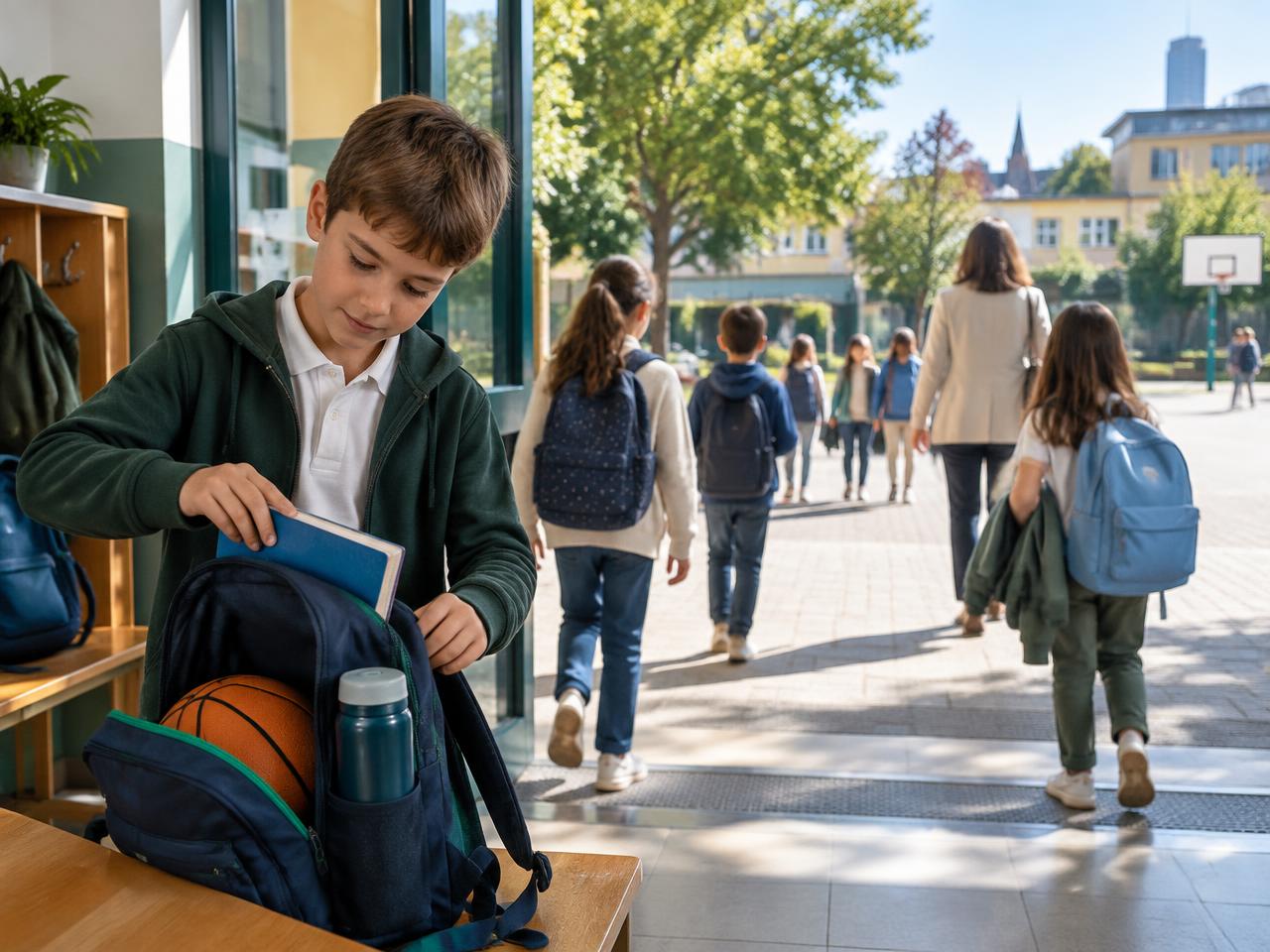
The school day does not begin with the first class, nor does it end with the final bell. The organization of the school day determines whether a child moves through their obligations calmly and confidently or in a rush, with scattered thoughts and a constant feeling of being behind. For a family that takes education seriously, a well-organized day is not a convenience. It is the foundation of work habits, responsibility, and inner discipline.
A child needs a clear rhythm, predictable rules, and adults who consistently look after every part of the day. This does not mean every minute must be filled. On the contrary, order also includes time for rest, conversation, movement, and quiet independent work. The difference is that no important part of the child's development is left to chance.
Why the organization of the school day is an educational matter
A good schedule does not serve only to ensure that the lesson content is successfully covered. It gradually teaches the child that an obligation has its place, that work begins on time and ends carefully, and that rest comes after effort has been invested. Such habits later arise not from reprimands, but from daily repeated order.
At a younger school age it is especially important that the child does not bear the burden of independently managing the whole day. They are still learning to judge how much time they need, when their attention fades, and how to prepare materials for the next task. That is why it is the role of the school and the family to set a framework that is firm yet age-appropriate.
When the day is uneven, homework is often pushed into the evening hours. Family conversation is then replaced by fatigue and negotiation, and the child begins to associate school with constant pressure. When work is distributed throughout the day, the evening hours can again belong to the family, to rest, and to preparing for calm sleep.
What makes up a well-organized school day
All-day organization requires more than a sequence of classes. Instruction, nutrition, physical activity, rest, and independent work must be connected according to children's real needs. Each of these segments has an educational purpose, and none should be viewed as an incidental addition.
Lessons at the time of greatest attention
The most demanding content requires a rested child and a teacher who can follow their work. In small classes it is easier to notice when a student understands the material and when they are merely keeping pace with the group without really absorbing the knowledge. Individual monitoring does not mean lowering standards. It means that every student is expected to progress, with an appropriate path and clear feedback.
The national curriculum provides a shared educational foundation, and its expanded scope allows knowledge not to be reduced to memorizing facts. Through project work, workshops, themed days, and open classes, the student learns to connect content, speak clearly, and take responsibility for what they have prepared. The mother tongue holds a special place: reading, writing, the Cyrillic script, and literature are not just subjects, but tools of thought and belonging.
Meals as part of order and health care
A child who skips a meal has a harder time maintaining attention, and a child who eats in a hurry does not even absorb basic table manners. That is why nutrition at school is not a logistical matter to be solved in passing. Four daily meals, scheduled in line with the rhythm of lessons and activities, provide energy for work and free parents from the daily uncertainty of whether the child ate properly during the day.
The educational aspect also matters. A meal is an opportunity to practice politeness, patience, gratitude, and responsibility toward shared space. These habits are not small. They carry over into how one treats others, work, and family.
Movement, a break, and the return of concentration
Rest is not a void between two tasks. After intensive work a child needs to change position, talk, go outside, or take part in physical activity. Movement contributes to health, as well as to the student's ability to return to learning focused.
Still, a good break is not the same as unlimited time without direction. Children need safety rules, supervision, and a culture of mutual respect. Free time at school should be a protected space in which a child can relax without being exposed to rudeness, boredom, or inappropriate influences.
Independent work under expert guidance
The greatest practical value of a well-organized day is the time set aside for independent work. The child then reviews material, does assignments, and learns how to face difficulty without giving up immediately. The teacher is not a substitute for the student's effort, but is an expert support who guides, checks the process, and prevents a mistake from going unnoticed.
A sense of measure is needed here. If an adult solves every task instead of the child, the child remains dependent on help. If the child is left alone with material they do not understand, frustration grows. Properly guided independent work builds exactly what parents want to see: a student who knows how to ask, try, check, and finish what they started.
Organization of the school day and a calmer family life
Parents do not ask the school to replace the family. They seek a partner who will maintain the same direction of upbringing throughout the day: respect for obligations, polite speech, care for health, and clear boundaries. When the school takes responsibility for the whole school day, the parent gains a reliable insight into the child's work, not just a list of tasks to be solved at home.
Such a system reduces everyday tension around transportation, meals, homework, and screen time. This does not mean the parent becomes less involved. Their role becomes more substantive: instead of monitoring the notebook in the evening, they can talk with the child about what they learned, about relationships with peers, and about the values they are adopting.
Regular, clear communication between the school and parents is therefore essential. It is necessary to talk about both progress and difficulties, without embellishment. A child progresses best when they see that parents and teachers share the same standards and that agreements are honored.
Order does not stifle childhood - it gives it support
Structure is sometimes mistakenly interpreted as the opposite of childlike spontaneity. A child, however, does not become freer when there are no boundaries, but when they know what is expected of them and feel safe within that framework. Rules allow them to spend their energy not on constantly testing limits, but on learning, friendships, play, and the development of their own abilities.
A good system must leave room for differences among children. Some need more time for reading, some need an additional explanation of a mathematical process, and some need encouragement to be bold and speak in public. However, adapting is not the same as yielding. The standard remains clear: work is respected, knowledge is acquired conscientiously, and the way one treats others must be dignified.
At the Private Primary School "Mihajlo Pupin," the all-day rhythm connects lessons, independent work, rest, physical activities, and four meals into an organized whole. Such an approach does not promise a day without effort. It provides something more valuable: conditions in which effort has meaning, knowledge is acquired thoroughly, and the child practices responsibility every day.
The best indicator of good organization is not an overloaded schedule, but a child who returns home calmer, with completed obligations and ever more confidence in their own ability to work. Such a day becomes a habit, and a habit over time becomes character.