
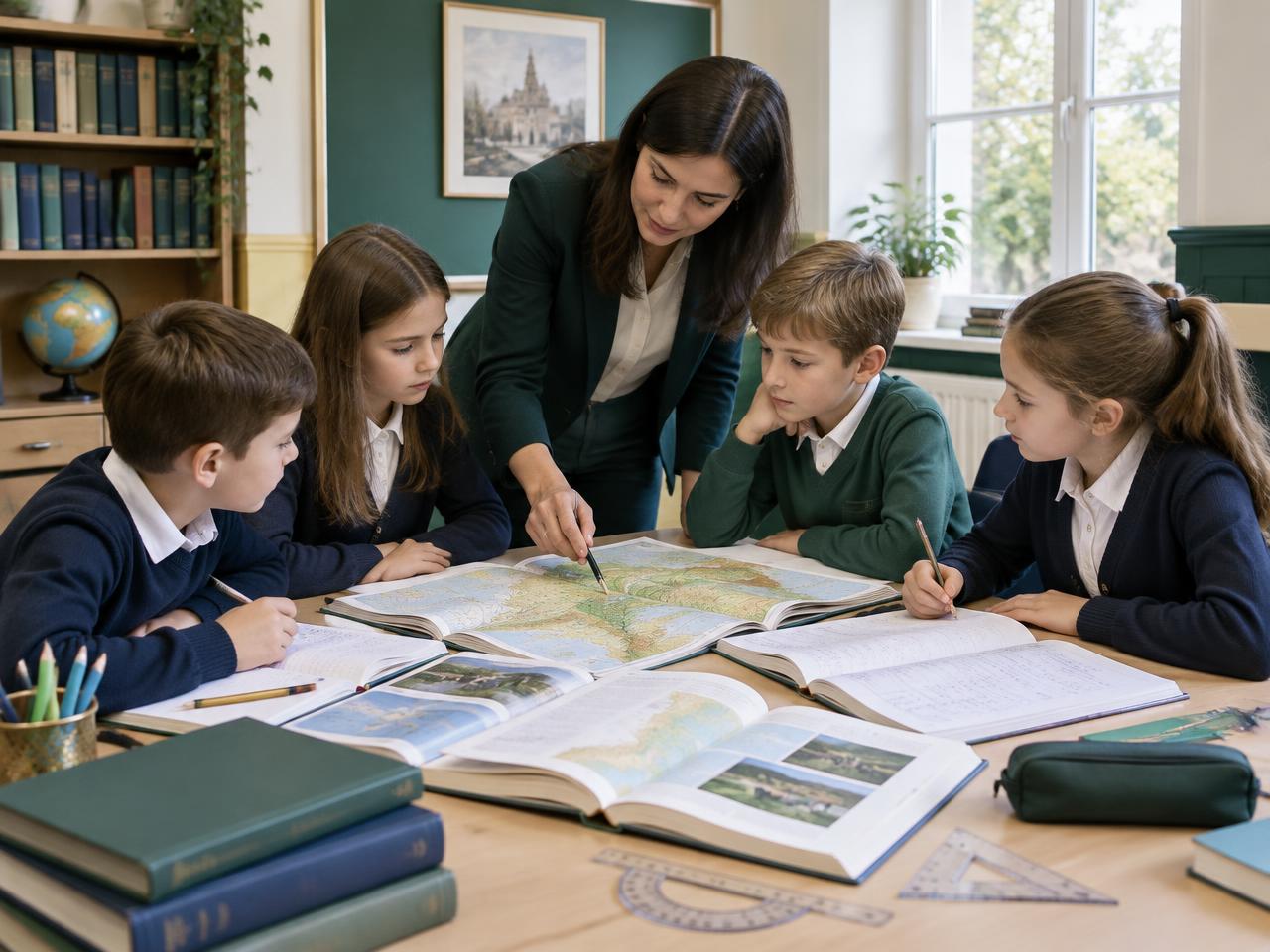
A child in primary school does not acquire merely a sum of facts to display on a test. They learn how to listen, read with comprehension, speak clearly, respect a deadline, finish a task, and take responsibility for their work. That is why the national curriculum is much more than a list of subjects and lesson units. It is the shared educational framework on which knowledge, language culture, a work ethic, and awareness of belonging to one's own community are built.
For a parent choosing a school, the real question is not only whether the curriculum is being delivered. That is a given. What matters is how it is delivered: does the child have enough time to understand the material, does the teacher track their progress, does the school day have order, and is knowledge linked to upbringing. The answers to these questions determine whether the curriculum remains a formal obligation or becomes a reliable foundation for the child's development.
What the national curriculum gives a child
The national curriculum sets out the content, outcomes, and standards a student should master during primary education. Its value lies in giving every child the right to a serious, systematic education, regardless of which school they attend. Serbian language and literature, mathematics, the natural and social sciences, history, geography, art, and physical education are not disconnected classes. Together they shape general culture and the ability to understand the world as a whole.
The mother tongue holds a special place. A child who does not read carefully, does not understand what they have read, and cannot express their thought neatly will struggle to demonstrate knowledge in other subjects as well. Cultivating the Serbian language, the Cyrillic script, and literature is therefore not a matter of form or nostalgia. It is work on thinking, memory, expression, and cultural self-confidence.
The same applies to history and geography. Knowing one's own people, the land we live in, important events, and cultural heritage helps a child gain a sense of measure. They should not memorize dates without meaning, but understand causes, consequences, and the value of a responsible attitude toward tradition. Tradition is not an obstacle to contemporary knowledge. It is the compass of ideas that gives knowledge direction.
The curriculum is a minimum, and the school system makes the difference
Two schools can follow the same curriculum yet offer a completely different experience to the student. The difference arises in the organization of work, the size of classes, the consistency of rules, and the school's willingness not to leave the child to themselves once the class is over.
When a class is smaller, the teacher more easily notices whether a student truly understands a process or has merely memorized an example. They can react before a small gap in knowledge becomes a serious problem. Individual monitoring does not mean lowering standards or singling the child out from the group. On the contrary, it means that every student is expected to progress according to a clear standard, and that help arrives on time.
An expanded scope of work makes sense only if it is carefully structured. More time at school is not an advantage if it is filled with random activities or constant workload. A child needs rhythm: focused instruction, time for independent work, rest, movement, a meal, and conversation with the teacher. In this way, the school day does not become a mere series of obligations, but an organized whole in which the child gradually learns to manage their own time.
At the Private Primary School "Mihajlo Pupin," the national curriculum is delivered in an expanded form through all-day instruction. Such a schedule allows the student to complete a significant part of their school obligations under expert supervision, instead of carrying them home as a burden for the family. The parent remains an important support for the child, but the home regains room for conversation, rest, and family life.
The national curriculum and work habits
Knowledge without a work habit often remains short-lived. A student may be bright and curious, but without order they will struggle to achieve what their potential promises. Work habits are not created by a single major decision, but through the repetition of small, clear actions: arriving on time, preparing materials, listening attentively, finishing a task, and accepting correction.
Here the school plays an irreplaceable role. A child is not expected to organize complex obligations alone, without support. They are expected to learn, with guidance, how it is done. The teacher sets the requirement, explains the process, checks completion, and asks the student to persevere. Such consistency is not strictness for its own sake. It gives the child security, because they know what is expected of them and what well-done work looks like.
Independent work within the school day is especially important. That is when the teacher sees how a student approaches a task when there is no immediate answer in front of them. Do they read the instructions carefully? Can they determine the order of steps? Do they ask for help in the right way? A parent often cannot gain such insight from a single grade, yet it is precisely such observations that reveal the development of responsibility.
Upbringing is not an add-on to teaching
Sometimes the school's educational role is presented as something separate from academic work. In reality, the way a student speaks, sits in class, treats a classmate, takes care of shared space, and accepts authority affects their ability to learn. A school that wants high academic results cannot be indifferent to behavior.
Clear rules do not constrain a child's dignity. They protect it. In a safe and organized environment a child does not have to spend energy figuring out unclear boundaries. They know that respect is mandatory, that effort is valued, and that a mistake is corrected. They learn that freedom is not the absence of obligations, but the ability to carry obligations conscientiously.
Project work, workshops, themed days, and open classes can greatly enrich the program when they stem from the knowledge gained in class. A good project requires reading, checking facts, dividing tasks, a tidy presentation, and responsibility toward the group. An open class does not serve as a performance, but shows that the student can explain what they have learned. Activity without content quickly fades; knowledge a child can apply stays with them.
An all-day rhythm preserves both knowledge and health
Parents rightly expect the school to care about the child's whole day, not just the time spent in lessons. At an age of intense growth, attention and success also depend on sleep, nutrition, movement, and regular breaks. That is why meals, physical activities, and rest are an integral part of serious organization, not incidental conveniences.
An all-day school should not resemble an extended working day for adults. Its purpose is to carefully balance effort and recovery. After demanding mental work, a child needs movement; after rest, they can return to focused independent work. Four daily meals, with supervision and table manners, further bring order into the daily routine and support healthy habits.
Such an organization requires a high degree of institutional responsibility. Safety, the presence of adults, clear transitions between activities, and regular communication with parents are not secondary administrative matters. They are conditions of trust. A parent who entrusts their child to the school for the whole day must know that the school understands the child's rhythm, monitors their work, and reacts when a change appears in performance, behavior, or mood.
Partnership between parents and school
No school can replace the family, just as the family cannot take over all the school's tasks. A child progresses best when the adults around them send a consistent message: knowledge is a value, work is an obligation, decency is the standard, and effort is not postponed until tomorrow.
This partnership does not mean the parent should solve homework every day or negotiate over every demand. Their role is to respect the school's order, follow the child, and talk openly with the teachers. The school's role is to give the parent an accurate picture of progress - both when the child achieves excellent results and when they need extra support.
When choosing a school, it is therefore worth looking beyond attractive premises and a rich schedule. Ask how each student's work is monitored, when obligations are completed, how the Serbian language is cultivated, how difficulties are resolved, and how the school builds character. The national curriculum achieves its full value only when it is carried out every day with knowledge, order, and respect for the child who is still growing.