
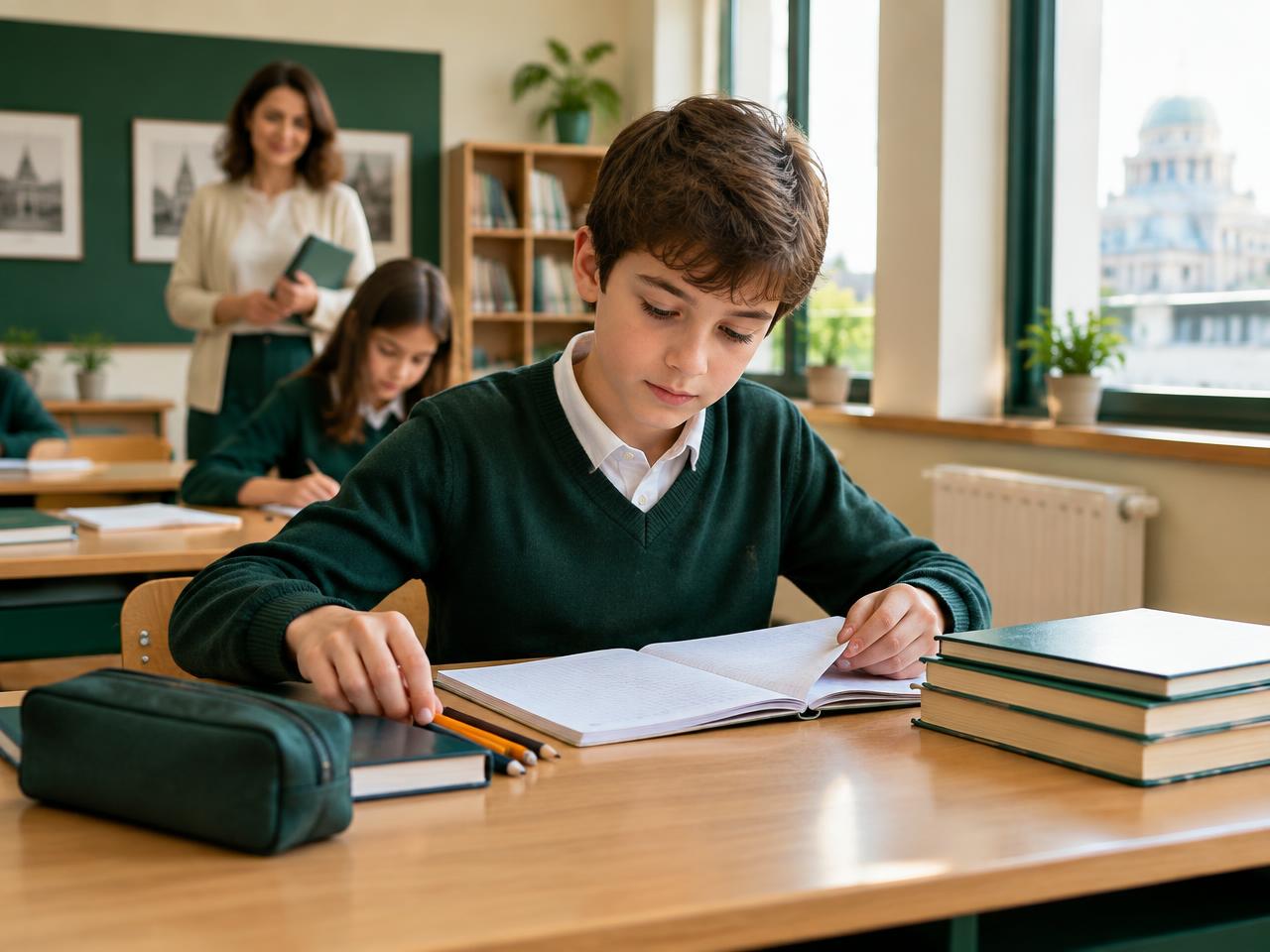
Choosing a school is not only a matter of textbooks, grades, and class schedules. When a parent chooses a private school, they are choosing an environment in which the child will learn every day how to work, how to communicate, how to respect obligations, and how to take responsibility. That is precisely why it is necessary to look beyond promises of modern methods and extra content. What is decisive is that the school has a clear system, stable standards, and an educational stance.
Primary school age is a time when foundations are laid. Knowledge gained during that period is important, but it has lasting value only when accompanied by a work habit, respect for rules, proper expression, and the awareness that success is not accidental. A child who learns to start a task on time, to persevere when the material is demanding, and to accept a justified remark gains support for their entire life.
What parents are really choosing when they choose a private school
A good private school should not be a substitute for the parental role, but its reliable ally. The family establishes the first values, and the school confirms them daily through order, expectations, and an attitude toward work. If a child hears at home that effort and decency matter, and at school encounters clear rules and consistent adults, they receive a unified educational framework.
That is why it is useful to ask a simple question: what does an ordinary school day look like? It is not enough for a program to sound good on paper. A parent needs to know who watches over the child while they do homework, when they have time to rest, how disagreements among students are resolved, whether the teacher knows their progress, and how speech culture is nurtured. The quality of a school is most clearly seen in everyday life, not only at performances and special events.
All-day organization gives this everyday life order. Lessons, independent work, meals, physical activity, and rest do not remain disconnected parts of the day. They become a whole with a clear rhythm. Such a rhythm is not a burden for the child when it is suited to their age. On the contrary, it frees the child from uncertainty and teaches them that time has its own value.
A private school and the advantage of a small class
A small class is not just a more pleasant setting. It allows the teacher to notice when a student understands the material and when they are merely repeating it. It also allows uncertainty in reading, mathematics, writing, or oral expression to be recognized in time. The child then does not go unnoticed while a gap in knowledge deepens.
Individual monitoring does not mean lowering standards. Its purpose is for every student to be asked to progress according to their abilities, but with a clear obligation to work. One child will need extra grammar practice, another encouragement to read a task more carefully, and a third a more demanding challenge because they easily master the regular material. Fairness in education does not mean that all children receive the same thing, but that everyone receives the attention and guidance they need to progress responsibly.
In such an environment the teacher is not merely a lecturer. They are an authority who sets boundaries, monitors development, and shows the student that knowledge is gained through work. Authority is not built through strictness for its own sake, but through consistency. A child quickly recognizes when an adult actually follows through on what they say.
Independent work as part of the school day
One of the greatest values of well-organized all-day instruction is the time dedicated to independent work. Homework should not be left to the family's evening exhaustion, after work, traffic, and other obligations. When a child does assignments at school, under professional supervision and at the scheduled time, they gradually learn to plan, check, and complete their obligations.
This does not mean the parent stops taking an interest in school. On the contrary, their role becomes more meaningful. Instead of a daily battle over the notebook, the parent can talk with the child about what they have learned, follow their attitude toward work, and openly exchange observations with the school. A partnership between parents and school rests on regular communication, mutual respect, and the same intention - the wellbeing of the child.
Knowledge in the mother tongue and cultural support
Primary school has a duty to give a child knowledge, but also the language with which to understand, communicate, and defend that knowledge. Cultivating the Serbian language, the Cyrillic script, literature, history, and geography is not a step backward. It is an educational foundation without which a child can hardly build a complete view of themselves, their family, and the community to which they belong.
The mother tongue develops the ability to think. A student who can read a text carefully, construct a clear sentence, and explain their position progresses more easily in other subjects as well. That is why language classes must not be reduced to a passing mastery of spelling rules. Reading, discussing literature, oral presentation, and cultivating a rich vocabulary develop inner discipline of thought.
Cultural identity is likewise not conveyed through declarations. It is built through a daily relationship with language, holidays, historical facts, art, and family values. A child should know where they come from so that they can understand the world around them with confidence and respect. Openness to the world makes sense only when it rests on a firm identity.
Safety, health, and the dignity of everyday life
A parent who entrusts a child to a school must also have confidence in its attitude toward safety. A safe environment is not reduced to controlling entry into the building. It includes supervision throughout the entire day, clear rules of conduct, timely response to conflicts, and a culture in which no one is humiliated or left without support.
Discipline in this sense is protection, not punishment. Rules give children boundaries within which they can calmly work, learn, and develop relationships. When the consequences of inappropriate behavior are known and consistent, students learn that freedom is not the absence of obligations, but the ability to choose responsibly.
Health is part of the same system. Four balanced meals, time for rest, and physical activities are not a secondary convenience. A child who is hungry, tired, or inactive for too long struggles to maintain attention and to absorb material. A structured school day cares for the whole child - their mind, body, habits, and sense of security.
How to assess whether a school is the right choice
Parents often compare programs, location, and price, which is understandable. Still, the final decision should take in the bigger picture. It is worth discussing how the school monitors student progress, how it organizes independent work, how it maintains contact with parents, and what response it gives when a child encounters a difficulty.
Attention should also be paid to the language the school uses when speaking about children. A serious institution does not promise that every day will be easy and fun. It knows that learning sometimes requires effort, repetition, and patience. But it also knows that a child must not be left alone facing those demands. Their work should be guided, noticed, and valued.
The Private Primary School "Mihajlo Pupin" bases its work on an expanded national curriculum, small classes, and an all-day organized school day. Such an approach starts from a simple yet demanding idea: knowledge achieves its full value only when it becomes a virtue, and responsibility a habit.
A parent cannot remove every difficulty from a child's path in advance, nor would that be good. They can, however, choose a school in which the child will have order, support, and standards by which to grow. When knowledge, character, and family values are connected in everyday work, the school becomes a place where the child gains not only grades, but also the ability to carry their obligations with dignity.